





New Publication: Could Stress Be Quietly Triggering Your Afib?

A few years ago, we launched a poll asking people what they believed their trigger for atrial fibrillation (Afib) was. Stress was mentioned as one of the most common triggers for Afib and this led us to develop a survey to collect more insights on how stress is experienced.
Fastforward, we now published these insights in a new peer-reviewed article, co-authored by our own team together with the Department of Physiology at Amsterdam UMC, the Athena Institute at VU Amsterdam, and colleagues at Erasmus MC.
This article brings lived experience together with the underlying biology of stress for the first time.
The authors’ describe this approach as completing the “translational circle” from molecular mechanisms to citizen science.
Here’s what we know so far about Afib and stress:
- A new review, published in the European Journal of Preventive Cardiology, pulls together everything currently known about psychological stress and Afib.
- Chronic stressors such as high-strain jobs and involuntary unemployment are linked to a higher risk of new-onset Afib in several large population studies.
- Evidence that everyday, ‘in-the-moment’, perceived stress alone causes new Afib is weak and mixed.
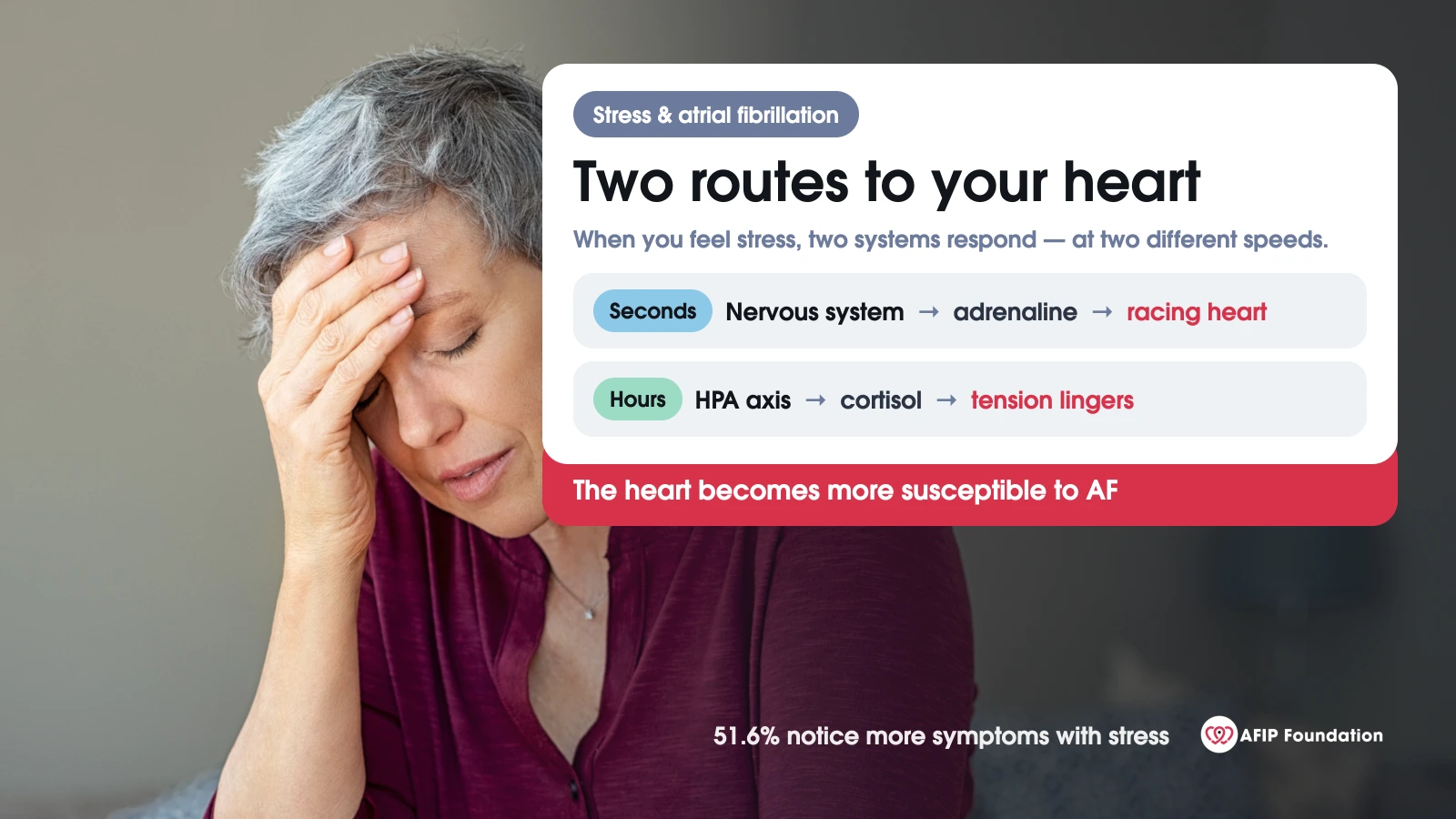
- Stress reaches the heart through two real biological routes: a fast one via the nervous system (adrenaline and noradrenaline) and a slower one via the hormone system (the HPA axis and cortisol).
- In AFIP’s own survey of 667 people with Afib, over half of the respondents said stress worsens their symptoms, and more than two in three reported palpitations during stressful moments.
- The research team is now asking for your help: filling in the ongoing AFIP stress questionnaire feeds directly into the next phase of this work.
Our new publication connects the dots between stress and Afib
The paper, titled “The Role of Psychological Stress in Atrial Fibrillation: Completing the Translational Circle from Molecular Mechanisms to Citizen Science,” was written by a team spanning the Department of Physiology at Amsterdam UMC (Amsterdam Cardiovascular Sciences), the Athena Institute at VU Amsterdam, Erasmus MC, and the AFIP Foundation itself. It was carried out as part of CIRCULAR, the NWO-funded consortium that studies Afib together with patients.
What makes this review different from most others, is that it does not stop at summarising lab and hospital data. It also brings in the perspective of people actually living with Afib, gathered through AFIP’s own citizen-science surveys, and places it alongside biology.
The publication offers a fuller picture of how stress and Afib actually relate to each other and sheds light on where the real gaps in our understanding still sit.
How stress reaches your heart, biologically
When you perceive something as stressful, two systems respond on two different timescales.
The fast one is the nervous system. Within seconds, it releases adrenaline and noradrenaline. These are the hormones behind a racing heart and give that jittery, on-edge feeling.
In animal studies, higher levels of these hormones increased both heart rate and how easily Afib could be triggered. In people, higher noradrenaline levels measured before heart surgery were associated with a higher chance of developing Afib afterwards.
The slower one is the hormone system, specifically the HPA axis. This is a signalling chain that runs from the brain to the adrenal glands and ends in the release of cortisol, which the body’s main stress hormone.
This system takes longer to respond and longer to switch off again. This is part of why prolonged, chronic stress behaves differently in the body than a single stressful moment.
Neither pathway proves that stress causes Afib on its own. But together they give a plausible, biological reason why stress could act as a triggerfor people who already have the Afib.
Or which other underlying condition?
Stress can raise your Afib risk but not all stress is the same
Several long-running studies have looked at chronic stressors and Afib risk over time.
People in high-strain jobs, working with heavy demands and little control over how they do it, showed a higher risk of developing Afib in multiple European cohorts. Additionally, involuntary unemployment was linked to increased odds of Afib too. The strongest effect was seen in people who felt they had no control over losing their job, rather than being unemployed itself.
Stressful life events such as grief or job loss also came up repeatedly as linked to a higher chance of developing Afib, although the size of that link varied noticeably between studies.
Interestingly, evidence linking everyday perceived stress to new-onset Afib is far less consistent. This refers to the general feeling of being stressed without a specific chronic trigger. Several studies found no clear association.
That does not mean perceived stress is irrelevant. It appears to matter more for how Afib feels and behaves once someone already has it, which is exactly where AFIP’s own community data comes in.
The stress-Afib connection through patients’ eyes
In an earlier AFIP poll of 1,051 people with Afib, stress came out as one of the most frequently reported personal triggers. That result is what set this whole research line in motion.
A follow-up questionnaire, gathered 667 responses (average age 63, 63% women). On average, participants rated their stress at 2.9 out of 5.
During stressful episodes, 68.2% reported palpitations and 18.7% reported fatigue. Work (26.4%) and health worries (22.4%) were the most commonly named sources of stress, alongside general anxiety and uncertainty about the future.
Just over half of respondents (51.6%) said psychological stress increases their Afib symptom burden, and 10.7% said stress or strong emotion can trigger an episode almost immediately.
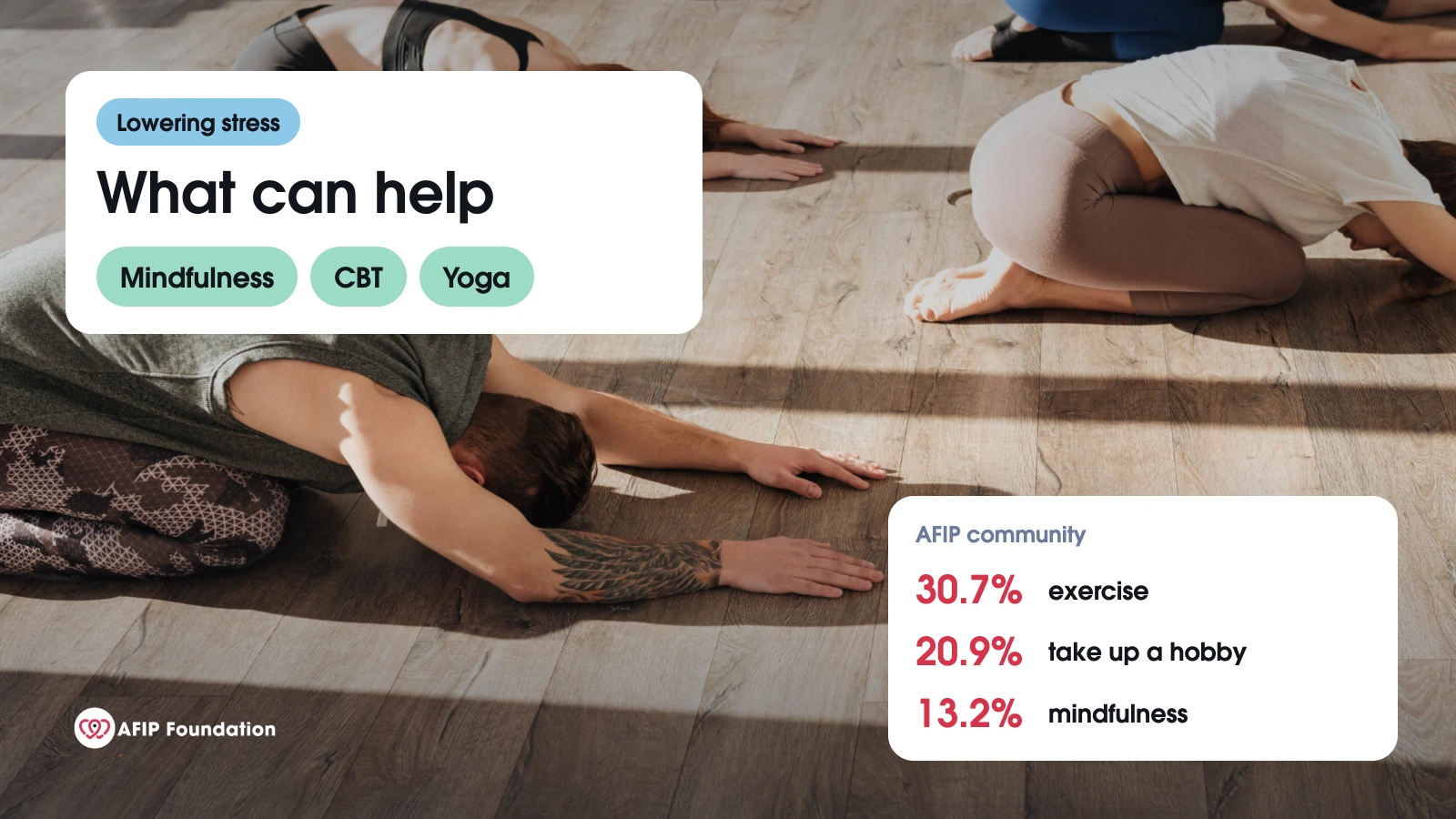
The most common ways people said they coped with stress were exercise (30.7%), pursuing a hobby (20.9%), and mindfulness practice (13.2%).
Fear turned out to matter too. People who reported being more prone to fear reported significantly higher stress levels.
Using a language-analysis model,researchers sorted open-ended answers about the origin of that fear into themes. The most common were fear related to health or death (31.1%), fear of losing control, for example over work (14.4%), fear of failure or social rejection (11.1%), and fears connected to family or relationships (10.8%).
These findings cannot prove cause and effect. However, it does offer something population statistics alone cannot: a direct, patient-reported picture of how stress actually shows up in daily life with Afib.
What this means for you
If you notice your Afib symptoms tend to flare up around stressful periods, you are describing something a majority of AFIP’s community also reports. And there is a plausible biological explanation behind it.
Stress is one of the more trackable factors. You can keep track of what triggered it, how it felt, and whether symptoms followed. These are all things worth jotting down over a few weeks to see whether a pattern emerges for you specifically.
Unfortunately, there is not yet a single Afib guideline that specifically recommends stress management. However,the review’s authors share some approaches that may help::
- Mindfulness
- Cognitive behavioural therapy
- Yoga
These can complement standard risk-factor management strategies such as exercise and weight control.
Notably, these are also the strategies people in AFIP’s survey were already turning to on their own.
What do the official guidelines say?
The 2024 ESC Guidelines for the management of atrial fibrillation, direct clinicians to address comorbidities such as hypertension, heart failure, diabetes, obesity, sleep apnea, physical inactivity, and high alcohol intake.
Psychological stress isn’t on that list. At least not yet. The guidelines are explicit about why and they state that psychosocial and environmental factors in Afib remain too understudied to support a formal recommendation.This review, and the AFIP community data behind it, are a look into that gap.
Help write the next chapter of this Afib and stress research
This publication exists because people with Afib were willing to share their experience. The research team wants to take that further with an ongoing questionnaire on stress and Afib, open now on the AFIP platform. It takes about 5–8 minutes, can be filled in anonymously, and feeds directly into the next phase of this research.
Curious what else the AFIP community is currently helping investigate? Take a look at our ongoing research and surveys.
As always, this article is not medical advice: speak with your healthcare provider before changing anything about your treatment or daily routine.
Do you know someone who might be interested in this?


Related articles

The Role of Desmin Variants In Familial Atrial Fibrillation

Atrial fibrillation (AF) is the most common sustained cardiac arrhythmia in the Western world. AF is closely correlated with traditional risk factors. Traditional risk factors include lifestyle related hypertension, diabetes

How Do I Prevent Atrial Fibrillation In the Summer Heat?

Does atrial fibrillation (AFib) increase in hot weather? How do dehydration, electrolytes, heat exhaustion, and air pollution affect AFib? Do UV and vitamin D play a role in increasing AFib?
Ozempic and Wegovy also useful for Afib?
Did you know that the same medications millions of people take for weight loss and type 2 diabetes might also be protecting them from atrial fibrillation? Semaglutide, the active ingredient